
Natural vs. Synthetic: Advanced Detection Methods
A B2B guide to identifying laboratory-grown diamonds using gemological instrumentation.
Exchange Member · Exporter, Importer & Manufacturer · 35+ Years
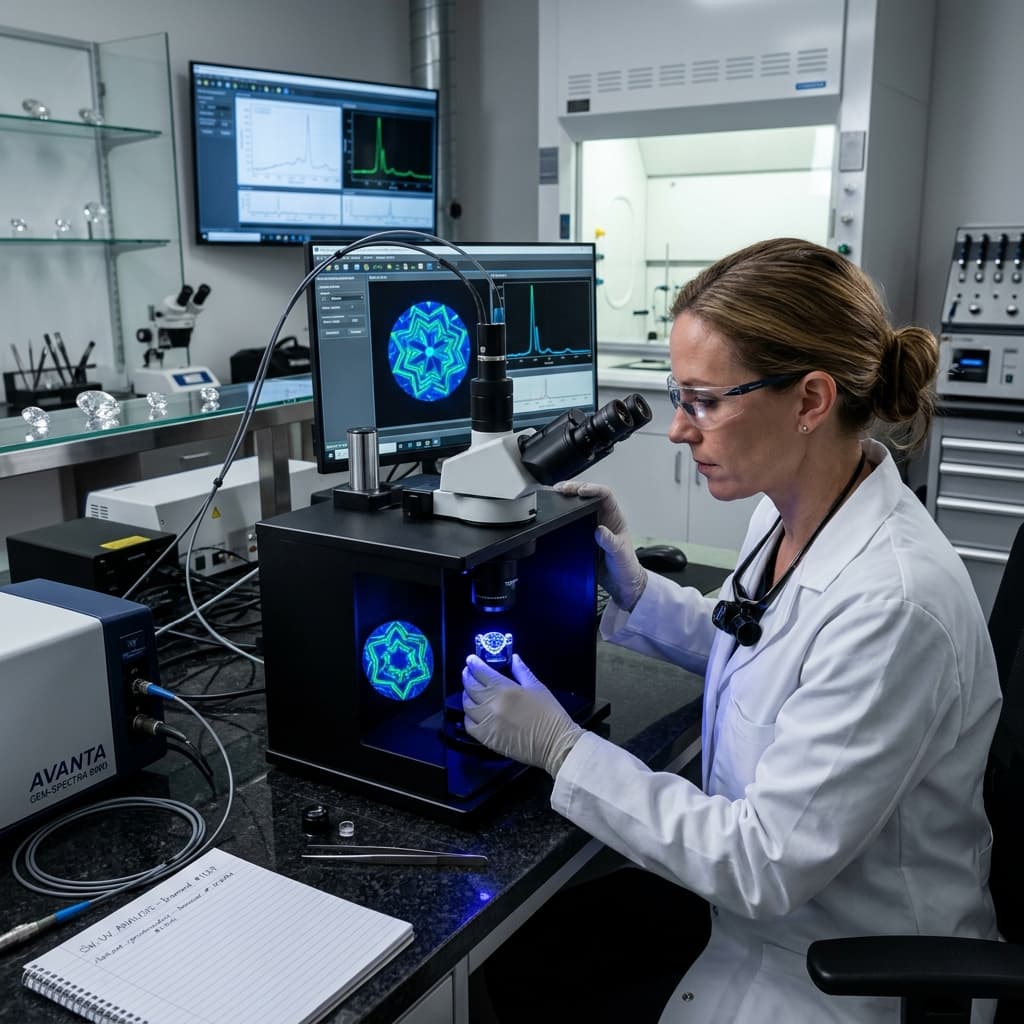
Because laboratory-grown diamonds have essentially the same chemical and optical properties as natural diamonds, a conventional thermal tester cannot establish growth origin. GIA advises submitting a stone to a gemological laboratory for advanced testing when confirmation is required; see its identification guidance.
Key Diagnostic Identifiers
Advanced screening looks for specific growth and structural signatures:
- UV Fluorescence Imaging: Short-wave UV imaging can reveal growth-related fluorescence patterns. The observed structures may help distinguish natural, HPHT-grown, and CVD-grown material, but the interpretation belongs within a broader laboratory examination.
- Photoluminescence (PL) Spectroscopy: PL spectroscopy can detect defect-related emissions associated with growth or treatment history. Laboratories interpret these features together with other spectra, imaging, and gemological observations.
- FTIR Spectroscopy: Fourier-transform infrared spectroscopy helps determine diamond type and measure defect-related absorption. Diamond type is a screening clue, not proof of natural or laboratory-grown origin by itself.
In-House Screening for Wholesalers
Desktop screening devices can pass stones with a natural signature and refer others for additional testing, but a referral is not itself an identification. GIA describes this workflow in its diamond research and screening guidance. For a high-value stone or a referred parcel, obtain a report or laboratory result that explicitly states growth origin and any detected treatment.
Related Reports

Interested in these findings?
For inquiries about current quotations, sourcing requirements, or inventory and grading-report status, contact our Ramat Gan B2B headquarters.
Contact Headquarters